Thursday, December 15, 2016

"The Boy With Pink Hair"

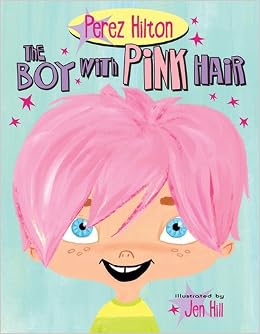
Image result for the boy with pink hair by perez hilton

The boy with pink hair is a wonderful story of a boy that came to school with pink hair. All the kids at school made fun of him for his bright colored hair. When he went out in public, people would also stare and make comments about his hair. The longer he was in school people started to talk to him and befriend him. As they became to know the boy, they began to find out his favorite things and what his interest were. The girl with ponytails became his first friend. The school had a big group lunch but the stove wasn't working. The girl with the ponytails said that she had an idea of who could help cook, the boy with pink hair. Everyone then began to help cook and everything they made was... you guessed it! PINK! This story illustrates a boys journey of being different. Along the way, people liked who he was but some made fun of who he was. As people got to know him they realized that he was just a regular person just as they were despite his difference in hair color. They included him in the same activities that they were doing and the boy with pink hair was a huge help in the situation. He was born with this hair color and couldn't change this about himself but he was proud of who he was. People began to realize that just because he had something different than they did, didn't make him less of a person than they were. 

This book can be a wonderful resource in the classroom to depict acceptance in the community. Despite our differences from one another, we can still accept people for who they are as they are just as important as the next person. 


How to be an Advocate for LGBTQ+ Students

Ally Yourself with LGBT Students

Whether or not you know their identity, you can be certain that you are teaching LGBT students. Visible support and small acts of kindness go a long way in helping these youth feel safer and find harmony at school. Not only does fulfilling the role of ally let them know they are not alone, it models for other students that gay and transgender classmates are their peers, worthy of respect and acceptance. More often than not, bullies operate with the tacit approval of the school community.


Here are six LGBT-friendly actions teachers and school staff can take to turn their classroom and hallways into Safe Zones.

1. Post a “Safe Zone” sign in your classroom and office. It signals to LGBT youth that you’ve got their backs.
2. Confront homophobic remarks, including slights and slurs that you overhear. Many students use terms like “fag,” “dyke” and “that’s so gay” without thinking. Let them know in no uncertain terms that such speech is unacceptable.
3. Seek opportunities to incorporate the contributions of LGBT people in science, history, athletics and the arts into your curriculum.
4. Don’t assume any student is gay—or not gay. If LGBT students do confide in you, thank them for their trust. Follow the student’s lead about what else you should do. Perhaps sharing this information is enough at this point. But if the student needs additional support, you can provide invaluable help by being versed in the LGBT-competent resources available in your school, district and community.
5. Organize or encourage district administrators to arrange an in-service with a qualified youth advocate about how to create a safer school for LGBT students.
6. If your school has a Gay-Straight Alliance, volunteer to act as its faculty advisor, or contribute in other ways.

Tolerance, Teaching. "Tips For Teachers: Ally Yourself With LGBT Students | Teaching Tolerance - Diversity, Equity And Justice". Tolerance.org. N.p., 2016. Web. 15 Dec. 2016.

LGBTQ+ Statistics for LGBT Youth


"Growing Up LGBT in America: View Statistics." Human Rights Campaign. N.p., n.d. Web. 15 Dec. 2016.

Monday, December 12, 2016

"Silence is Violence"


As future, current, and/or retired educators, it is important for us to realize that silence is violence.  By not speaking up and being complacent about certain issues, in this case implementing LBGTQ+ themes into curriculum and teaching about acceptance, we are making the situation worse.  With that being said, here are some helpful tips for teachers:
  • Talk to your school principal and/or superintendent and let them know about your concerns and/or yearning for the implementation of LBGTQ+ themes in the classroom
  • Get other teachers involved and let them know what you are doing in your classroom to implement these themes.  Give them ideas of lesson plans, book suggestions, tips for answering student/parent questions, etc.
Talk to students and let them know that you classroom is a safe place.  Be honest with your students about questions/concerns they may have.  Let them know that you will not tolerate disrespectful and judgmental remarks and that your classroom is a place in which everyone is accepted.

Why teachers/parents are afraid of implementing LBGTQ+ Themes in the classroom


  • Many educators fear retaliation and personal discomfort
  • Some teachers and parents believe that this is not a school issue and should not be mentioned in school.
  • Some consider it not to be “age-appropriate”
  • “Sexual innocence must be protected from the dangerous knowledge of homosexuality” (Flores)
  • “Many people fear that if children learn about LGBT people, homosexuality, or receive sex education in the upper grades, their knowledge will lead to the practice of homosexuality.” (Flores)
  • “A homophobic society fears that having LGBT-themed discussions, gay or lesbian parents, or gay or lesbian teachers on staff would influence or recruit young students to become gay.” (Flores)
Flores, G. (2012). Toward a More Inclusive Multicultural Education: Methods for Including LGBT Themes in K-12 Classrooms. American Journal of Sexuality Education, 7(3), 187-197. doi:10.1080/15546128.2012.707072

Literature that includes LBGTQ+ Themes:


It is extremely important the students can relate to characters in books.  Not only do students need to relate to characters, but they need to be able to see characters, values, and family dynamics that are different from their own. By showing students these differences, future generations will have a better understanding of those around them, be more inclined to have a more complex understanding of the world, and be more accepting of others. GLSEN-Inclusive Curriculum, offers several book titles for preservice, current teachers, and parents to consider into their classroom libraries and at home libraries.  Some of these include:
  • Heather Has Two Mommies By: Leslea Newman
  • Mommy, Mama, and Me By: Leslea Newman
  • Daddy, Papa, and Me By: Leslea Newman
  • The Family Book By: Todd Parr
  • Two Dads By: Carolyn Robinson
  • Some People Have Two Dads By: Luca Panzini
  • Red: A Crayon’s Story By: Michael Hall
  • Worm Loves Worm By: J.J. Austrian
  • Jacob’s New Dress  By: Sarah Hoffman
Not Every Princess By: Jeffrey Bone

LGBT-Inclusive Curriculum. (n.d.). Retrieved October 11, 2016, from http://www.glsen.org/educate/resources/curriculum

Awesome resources!!

As teachers, becoming more educated on ways to include LGBTQ+ themes in our classrooms is vital. Here are a list of many resource to help you become more aware of what to do!


1. Back-To-School Guide for Creating LGBT-Inclusive Environments. (n.d.). Retrieved October 15, 2016, from http://www.tapartnership.org/docs/back_to_school_guide.pdf

This is a simple guide with links to more resources about creating LBQT    inclusive classrooms. It lists 10 tips for creating this environment and each tip has at least one link that expands on this tip. 

2. Beren, M. (2013, October). Gay and Lesbian Families in the Early Childhood Classroom: Evaluation of an Online Professional Development Course. LEARNing Landscapes, 7(1). Retrieved October 15, 2016, from http://www.learninglandscapes.ca/images/documents/ll-no13/beren.pdf

This is an article that talks about gay and lesbian families in the school. There was a study done to see if teachers desired training around LGBT families of their students. Most of the teachers needed the training and felt uncomfortable and unaware of the LGBT families.

3. Boas, E. M. (n.d.). Chapter 13 Walking the Line Teaching, Being, and Sexuality in Elementary School.

This article discusses the importance of talking about sexuality in elementary schools instead of just pushing it under the rug.  Although it is a topic that is typically avoided in the traditional school setting, this article talks about how the conversations regarding sexuality are significant.  It stressed the significance of having open and honest lines of communication regarding sexuality with parents, teachers, and students.  

4. Books, Articles, Media - COLAGE: People with a Lesbian, Gay, Bisexual, Transgender, or Queer Parent. (n.d.). Retrieved October 15, 2016, from http://www.colage.org/programs/books-articles-media/

 This resource is an organization that focuses on uniting people who have LGBQT parents by supporting them as they empower one another to be confident leaders in society. It does not only aim for students in elementary school, but rather anyone. This page linked specifically has a variety of resources we can use while we learn about teaching students with LGBQT parents.

5. Chasnoff, D., & Cohen, H. S. (n.d.). It's Elementary-Talking about Gay Issues in School. Retrieved October 15, 2016, from http://www.groundspark.org/download/IE_Guide_08_Final.pdf

This resource looks to be an extremely helpful pdf that focuses on believing schools can be caring communities in which everyone has the opportunity to be engaged, included and respected, regardless of his or her sexual orientation or gender expression. 

6. DeWitt, P. (2015, July 10). 3 Reasons Why Many Schools Won't Offer LGBT Curriculum. Retrieved October 12, 2016, from http://blogs.edweek.org/edweek/finding_common_ground/2015/07/3_reasons_why_many_schools_wont_offer_LGBT_curriculum.html

This article discusses the counter arguments as to why many schools won’t offer LGBT curriculum.  With that being said, I think it is important to be knowledgeable about why schools are reluctant to include LGBT themes in the classroom and how we can go about changing that.  This article also stressed the importance of overcoming these obstacles in order to incorporate these themes to create an inclusive classroom. 

7. Fioriello, P., Dr. (2014). How To Support LGBT Families In Elementary School. Retrieved October 15, 2016, from http://drpfconsults.com/support-lgbt-families-in-elementary-school/

This resource talks about how to make students, families, faculty members, etc. feel accepted and welcomed, regardless of their sexual orientation/preference. This resource provides tips such as teaching tolerance to students and employees, avoiding segregating by gender, and recognizing same sex couples.

8. Flores, G. (2012). Toward a More Inclusive Multicultural Education: Methods for Including LGBT Themes in K-12 Classrooms. American Journal of Sexuality Education, 7(3), 187-197. doi:10.1080/15546128.2012.707072

This article discusses methods and ways of incorporating LGBT themes into the classroom. The author discusses the importance of reducing stereotypes and creating a more inclusive environment for all students. This article also gives examples and tips for talking to students about creating an inclusive classroom and being accepting of their peers. 

9. Hanlon, J. (n.d.). How Educators Can Address Homophobia in Elementary Schools. Retrieved October 15, 2016.

This resource addresses the topic of homophobia in elementary schools and dives into what we as educators can do to change this just by our own actions and behaviors in the classroom. I think this is something really important when addressing how to include LGBTQ+ themes in the classroom because we want all students to feel safe and aware, regardless of sexual orientation.

10. LGBT movement organizing to mandate “gay history” in schools across America. (2014, September 18). Retrieved October 15, 2016, from http://www.massresistance.org/docs/gen2/14b/GLSEN-Conference-040514/gay-history/index.html

This article talks about introducing gay history into the curriculum.  This resource talks about how by introducing gay history into the curriculum, that students will see the positive influence that popular figures have had on our society.   This resource also gives examples of lesson plans and ideas of how to successfully implement this into the classroom. 

11. LGBT-Inclusive Curriculum. (n.d.). Retrieved October 11, 2016, from http://www.glsen.org/educate/resources/curriculum

This resource provides information for educators to create lesson plans in order to create an inclusive classroom.  It provides examples of children’s books that would be appropriate to add to classroom libraries.  This resources also supplies professional development ideas for teachers that are passionate about including LBTQ+ themes into the K-6 classroom. 

12. LGBTQ-Inclusive Curriculum | Genders & Sexualities Alliance Network. (n.d.). Retrieved October 15, 2016, from https://gsanetwork.org/get-involved/change-your-school/campaigns/lgbtq-inclusive-curriculum

This resource talks about how including LBGTQ+ themes into the classroom is not only important, but necessary.  This resource also discusses the FAIR Education Act in California as well as ways to get a FAIR Education Act, or something similar, implemented in your state.

13. Pennell, B. S. (n.d.). 3.1 Classroom ideas. Retrieved October 12, 2016, from http://www.learnnc.org/lp/editions/LGBTQIA-resources/7900

This article provided tips and helpful ways to create a more inclusive and supportive classroom.  One particular section of this resource that I found extremely beneficial was the section regarding tips for teachers in regards to transgender, gender fluid, and gender-nonconforming students. This particular section stressed the importance of letting students use the restroom with the gender that they identify with as well as refraining from separating students by their gender. 

14. Raffaelli, L. (2014, August 14). Supporting LGBT Students in Your School. Retrieved October 15, 2016, from http://www.edutopia.org/discussion/supporting-lgbt-students-your-school

Like the other resources, this article gives more tips on how to include LGBTQ+ in the class and school. I also found it helpful that it talked about professional development with the staff to become more aware and how to be of help LGBTQ+ students in the school.

15. Rudolph, D. (2012). Elementary schools must teach about LGBT families. Retrieved October 15, 2016, from http://www.washingtonblade.com/2012/02/15/elementary-schools-must-teach-about-lgbt-families/

This article talks about how students today are not aware of same-sex parents. Children are under the impression that all families have a father and a mother and that same-sex families to not exist. It talks about the importance of teaching children about the world around them and not just pushing this topic under the rug. 

16. Sanders, A. M., & Mathis, J. B. (2013). Gay and Lesbian Literature in the Classroom: Can Gay Themes Overcome Heteronormativity? Journal of Praxis in Multicultural Education, 7(1). doi:10.9741/2161-2978.1067

After skimming this resource, I found it extremely educational as well as beneficial. It mainly focused on heteronormativity and touched on how silence is actually an act of anti-LGBTQ+ feelings. I think this is a huge issue in classrooms today and this resource has a lot of information to become educated about this topic.

17. Tips for Teachers: Ally Yourself with LGBT students. (n.d.). Retrieved October 15, 2016, from http://www.tolerance.org/toolkit/tips-teachers-ally-yourself-lgbt-students

This resource gives a few good tips on how teachers can ally themselves with LGBTQ+ in the school/classroom. Providing a safe zone for students, confronting homophobic remarks, and incorporating LGBTQ+ people into the curriculum

18. Utt, J. (2012). 10 Keys to Creating an Inclusive Classroom Community for LGBTQ Students. Retrieved October 15, 2016, from https://changefromwithin.org/2012/03/01/10-keys-to-creating-an-inclusive-classroom-community-for-lgbtq-students/

This resource gives a lot of information about LGBTQ+ in the classroom and schools including percentages and statistics regarding LGBTQ+ in the school system. This article gives 10 keys to having an inclusive classroom for LGBTQ+ students including the do’s and don’ts.

19. Very, B. N. (n.d.). ALGBTICAL. Retrieved October 11, 2016, from http://www.algbtical.org/2A EDUCATION.htm

This resource stressed the importance of making everyone feel included and getting to know parents and students on a personal level.  This page discusses the Association for Lesbian, Gay, Bisexual, and Transgender Issues in Counseling of Alabama.  The ALGBTICAL talks about many different topics such as creating a safe learning environment, openly gay teachers in public schools, and much more. 

20. Yeung, B. (2008). A Diversity Documentary: How to Cover LGBT Issues in the Classroom. Retrieved October 15, 2016, from http://www.edutopia.org/gay-issues-classroom

This article talked about how to successfully and appropriately implement LGBTQ+ themes into the classroom.  Although this article agrees that it is an important topic, it is one that needs to be taught in the right way.  This resource also discusses a documentary to watch/include in the curriculum entitled It’s Elementary.

Monday, November 28, 2016

How to support the community...as a teacher


Here is a simple list of ways you can support the students/staff/parents in circle who are a part of the LGBTQ* community  ↴

  1. Join a Gay Straight Alliance..or better yet, become a faculty sponsor!
  2. Educate your students!! Examples of this would be eliminating myths and misconceptions, giving truthful answers to students questions, and organizing informal discussions with students.
  3. Use class materials, like display posters, that include gay authors and historical figures. This is important!!
  4. Provide emotional and verbal support for LGBT youth and families that you come into contact with.
  5. Invite LGBT people to conduct classroom discussions about their jobs and family lives to students. This is so vital! Our students need to see this!
  6. Add/include books to your classroom library that have same sex families and transgender children, to show that the LGBT community is full of normal people like you and me. It just may look different. But we need to teach that difference is beautiful :)
  1. AbOVE ALL ELSE: You need to show and display tolerance, kindness, love, and acceptance to ALL students!

Flores, Gabriel. "Toward a More Inclusive Multicultural Education: Methods for Including LGBT Themes in K-12 Classrooms." American Journal of Sexuality Education 7.3 (2012): 187-97. Web. 12 Oct. 2016.

Preview of post's to come...

We plan to publish a few new posts in the next few weeks! We hope you are as excited as we are to read this new content from some of our contributors. To preview, we will have..

-a post explaining what you can do to support those around you in the LGBTQ* community
-a post about literature that includes LGBTQ* themes
-a post discussing specific literature you NEED to have in your classroom
-a post discussing why people are afraid to include these very important themes and how to respond to them

..keep your eyes peeled for some more awesome material coming your way soon!

Monday, November 14, 2016

BENEFITS of Implementing LGBTQ* themes in the classrom


Implementing LGBTQ+ themes will be extremely beneficial to students.  By implementing these themes into the classroom, students will have a better understanding of the fact that we all come from different backgrounds, have different family traditions, different values, different family dynamics, etc. According to Gabriel Flores, author of Toward a More Inclusive Multicultural Education: Methods for Including LGBTQ+ Themes in the K-12 Classroom, “the education regarding LGBT themes focuses on understanding and appreciating issues of difference, including the difference in sexual orientation, relationship, and the family structures, as well as the concepts of love and respect.  Implementing these themes into the classroom will help eliminate misinformation, prejudice, confusion, and stereotypes.” Including these themes into the classroom will promote healthy discussion and tolerance in and out of the classroom as well as focus on the kind and ethical treatment of all people. 
A common misconception around implementing LGBTQ+ themes into the classroom revolves around an idea that Flores explores in his article by stating that, “many people mistakenly believe that education about homosexuality focuses on the sexual behavior of homosexuals.”  Due to the fact that students’ parents were most likely not educated about this topic, they just assume that this is what is being taught when they hear that LBGTQ+ themes will be included into the classroom.
As stated previously, educating students on this topic will create a more inclusive and accepting classroom.  Flores goes onto state that, “with a more inclusive multicultural education that includes LGBT themes, children may base their knowledge and beliefs on accurate information and, ideally, without fear and bias change negative attitudes.” Without being educated, a more inclusive classroom cannot be achieved and students will base their opinions and theories from others around them (i.e. family, friends, media, etc.)


Flores, G. (2012). Toward a More Inclusive Multicultural Education: Methods for Including LGBT Themes in K-12 Classrooms. American Journal of Sexuality Education, 7(3), 187-197. doi:10.1080/15546128.2012.707072

A brief introduction

           In a world that seems to be full of hatred, malice, and injustice, the time to promote and enforce equality within the four walls of a classroom is long overdue.  As future educators, it is important for us to realize that our job is far more complex than just teaching content, but rather ensuring that our students are accepting of everyone regardless of their sexual orientation, culture, race, gender, etc.  This blog is an informative piece for preservice teachers, current teachers, etc., that value the importance of creating an inclusive and accepting classroom.  Although the main focus of this blog includes ways in which we can include LGBTQ+ themes into the classroom, we will also be discussing why it is not included as well as what we can do in order to make all students feel understood, appreciated, and accepted.